 Power Banks


 Brother Printers


 IP PBXs



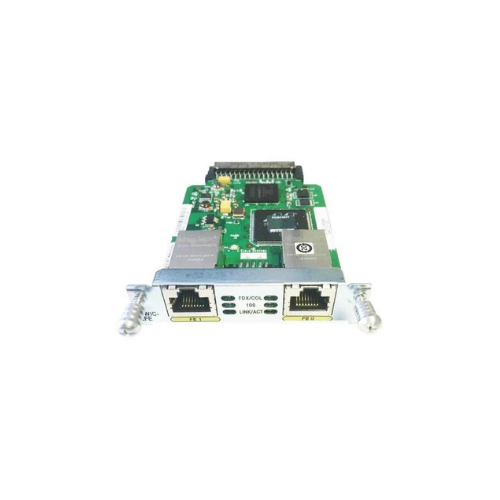

CISCO Router HWIC-2FE High-Speed WAN Interface Card
Key Features
Brand:CISCO
Interfaces: 2 x 10/100 Mbps Fast Ethernet (RJ-45)
Layer 3 Routing: Supports per-port ACLs, IP addressing, and routing protocols
VLAN Support: IEEE 802.1Q VLAN tagging
Form Factor: Single-wide HWIC
Compatibility: Cisco 3800 Series Routers (e.g., 3825, 3845)
IOS Requirement: Cisco IOS Release 12.4(15)T or later
1 Year Warranty
Cisco Router HWIC-2FE High Speed WAN Interface Card Product Overview
The Cisco HWIC-2FE High Speed WAN Interface Card balances fast ethernet routing expansion, enterprise network versatility, and reliable hardware engineering. Featuring two high-performance Layer 3 Fast Ethernet routing ports, this hardware component serves as an ideal solution for small-to-medium businesses and enterprise branch offices requiring secure, multi-homed WAN connections. Designed to expand your existing modular Cisco integrated services routers, this network card ensures seamless data throughput and branch office routing without needing to upgrade full routing chassis units
Modern enterprise networks require high availability and flexible bandwidth allocation, and this high-speed WAN card delivers on both fronts. It smoothly handles demanding data traffic workflows including branch office security protocols, dedicated demilitarized zone networks, and separate public or private internet connections. By adding dedicated physical routing interfaces to a modular system slot, it removes the performance bottlenecks of sharing single WAN ports across an entire facility. Whether you are setting up redundant service provider links or isolating local corporate departmental networks, this Cisco interface card offers enterprise-grade routing architecture in a compact modular layout.
Technical Specifications
| Feature | Specification |
|---|---|
| Interface Type | High Speed WAN Interface Card |
| Ports | Two Fast Ethernet Routing Ports |
| Speed Threshold | Ten or One Hundred Megabits Per Second |
| Connector Style | Standard RJ45 Ethernet Connector |
| Layer Protocol | Layer 3 Routing Capabilities |
| Form Factor | Single Wide Modular HWIC Slot |
| Compatibility | Modular Cisco Integrated Services Routers |
Core Product Capabilities
Dual Layer 3 Fast Ethernet Ports
-
- Provides two independent physical interfaces for flexible network topologies
- Supports auto negotiation to match ten or one hundred megabit speeds
- Enables direct assignment of independent internet protocol addresses per port
- Operates seamlessly with advanced Cisco command line configurations
Modular HWIC Slot Integration
-
- Slides smoothly into single wide high speed WAN interface card slots
- Maximizes system architecture efficiency by leaving larger network slots open
- Features a secure hot swappable design for simplified network servicing
- Draws balanced operational voltage directly from the router motherboard chassis
Comprehensive Protocol Support
-
- Interfaces fluidly with standard virtual local area network trunking protocols
- Supports access control lists for advanced hardware packet filtering
- Coordinates with dynamic enterprise routing protocols like OSPF and EIGRP
- Enables high availability network tracking with virtual router redundancy protocols
Performance and Workflow Optimization
Redundant WAN Load Balancing
The interface card utilizes dual Layer 3 ports to build secure backup network paths. This extra bandwidth allows network engineers to configure simultaneous links with separate internet service providers, ensuring corporate communications stay online during a carrier outage.
Efficient Enterprise Traffic Segregation
Branch infrastructure deployments benefit directly from the hardware design. Operating two separate fast ethernet lines allows tech teams to isolate public visitor wireless networks from secure corporate data storage environments. This technical versatility prevents external tracking threats from intercepting proprietary corporate data.
Data Security and Quality of Service Protocols
Advanced Quality of Service Controls
Network packet prioritization remains a primary asset of this hardware card. Through standard Cisco configuration tools, users can apply detailed priority rules to voice over internet protocol calls and critical remote database traffic. This management workflow ensures clear communications during spikes in general internet traffic.
Secure Border Gateway Routing
By deploying independent physical interfaces, network administrators can form clean demilitarized zones at the edge of the corporate network. This security approach guarantees that public facing application servers remain physically isolated from primary internal employee workstations, adding an effective layer of protection.
Network Architecture Utilization Guidelines
Branch Office Internet Gateway Duties
The dual port layout provides excellent real estate for branch office edge configurations. It comfortably hosts a primary high speed fiber internet connection on one interface while maintaining a secure digital subscriber line or cellular backup bridge on the second, eliminating the need for standalone secondary router boxes.
Local Inter VLAN Routing Expansion
For specialized office setups, this interface card offers a cost effective solution to expand local routing tables. Network staff can configure sub-interfaces on every port to route data between diverse local departments. This allows regional corporate offices to run localized multi network topologies with minimal hardware investment.
Primary User Benefits
Cost Effective System Scale
The card enables enterprise network managers to scale older modular systems without buying entirely new main router chassis units. This upgrade layer ensures that missing physical port capacity is resolved efficiently through standard plug-in expansion.
Standardized RJ45 Connection Layout
The universal interface ports accept standard category five or category six ethernet cabling. The familiar physical build ensures zero installation interference, dropping seamlessly into existing network server racks and cabling patches.
Unified IOS Management
The device coordinates completely with standard Cisco internetwork operating system tracking tools. Users can evaluate port traffic statistics, monitor line errors, execute secure software configurations, and track interface health from a unified terminal line interface